
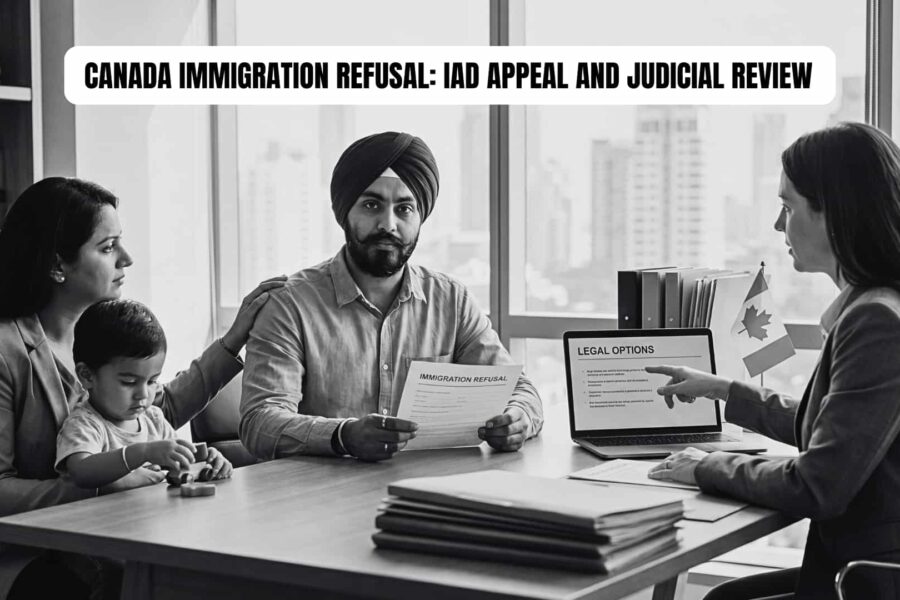
Many people assume that receiving an immigration refusal in Canada is the end of the world, but in most cases it is not. The Canadian immigration system supports applicants in many ways to challenge or respond to a negative decision. But challenging your case requires accurate knowledge and program details. So, it is necessary to understand why your application got refused. Then, depending on the situation, access what steps must be taken in order to turn a refusal into an approval.
Reasons for Immigration Refusal in Canada
IRCC is responsible for approving or refusing applications. Below are some common reasons due to which refusals occur:
- Incomplete applications or missing supporting documents
- Insufficient funds to support yourself or your family in Canada
- Doubts about intent to leave for temporary visas (visitor, study, or work permits)
- Misrepresentation, meaning IRCC believes false or misleading information was provided in the application
- Inadmissibility on criminal, medical, security, or financial grounds
- Weak ties to your home country for temporary applications
Before deciding how to respond, request your GCMS notes through an Access to Information and Privacy (ATIP) request. GCMS (Global Case Management System) notes contain the immigration officer’s detailed comments, documents, and reasons for the decision, while ATIP is the process used to obtain these records. Reviewing these notes can help you understand the refusal and prepare a stronger response.
What Steps Must Be Taken Immediately After Receiving a Refusal?
Read the Letter Carefully: This is the most crucial step. You must note the exact reasons, deadlines, and any appeal rights.
Gather Officer Notes: These are crucial for understanding the decision and preparing a stronger case.
Assess Your Situation: Check if anything has changed, like a new job, more money, or stronger ties. If nothing has changed, applying again with the same details will likely be refused.
Consult a Regulated Professional: An immigration lawyer or RCIC (Regulated Canadian Immigration Consultant) can review your application for errors. It is always recommended to consult an expert because sometimes you may miss important details while preparing or reviewing your case. You might not even realize those gaps, but an experienced lawyer can quickly identify and correct them, since they know exactly what to look for.
What Options Do You Have?
Option 1: Reapply With a Stronger Application
If we talk about temporary visas like study permits, work permits, and visitor visas, there is no formal appeal process. Usually, the best option is to reapply. If your refusal was due to a fixable issue (such as missing documents, proof of funds, or weak home ties), you can correct those problems and submit a new application. This is often quicker and less expensive than going to court. Make sure your new application directly addresses the concerns mentioned in your GCMS notes.
Option 2: Appeal to the Immigration Appeal Division (IAD)
An appeal is a full review of your case by the Immigration Appeal Division (IAD) of the Immigration and Refugee Board. However, you can only appeal in certain types of cases. You usually have the right to appeal to the IAD if your case falls into specific categories.
- Refusals for family sponsorship (like spouse, partner, parents, or children)
- Removal orders for permanent residents or protected persons
- Residency obligation appeals, when a permanent resident has not met the required time in Canada
The IAD can consider new evidence and may even weigh humanitarian and compassionate (H&C) grounds. This makes it a powerful option because the panel can look beyond the strict letter of the law. Most appeals must be filed within 30 days of receiving the decision, this is the deadline for sponsorship appeals. Residency obligation appeals run on a longer clock, with 60 days from receiving the removal order. If you have an IAD appeal right, this is usually the strongest path forward.
Option 3: Judicial Review at the Federal Court
If there is no appeal option, such as for most study permits, work permits, visitor visas, Express Entry, you can ask the Federal Court of Canada to review the decision through a judicial review. Judicial review is not a rehearing. The court only checks if the IRCC decision was fair and made correctly, not whether you should be approved. The court examines whether the IRCC officer’s decision was:
- Reasonable, meaning logical, justified, and supported by the evidence
- Procedurally fair, meaning you were given a proper chance to respond
- Free of legal error, such as misapplying the law or ignoring key evidence
If the court agrees the decision was flawed, it does not approve your application. It sends the matter back to IRCC to be re-decided by a different officer.
Judicial Review Deadlines
Strict timelines apply. You must file an Application for Leave and Judicial Review within:
- 15 days for decisions made inside Canada
- 60 days for decisions made outside Canada
The process has two steps. First, you must get the court’s permission to continue. The court only allows this if your case has a reasonable chance of success. If leave is approved, your case goes to a full hearing. Since strict deadlines and legal rules apply, it is strongly recommended to hire an experienced immigration lawyer.
Conclusion
If you have received an immigration refusal in Canada, then hold on because it is not always the final decision. You can reapply your application, appeal to the IAD, or request a judicial review, depending on your case and refusal reason. Just take it seriously, act quickly, get your GCMS notes, and seek professional advice from an immigration lawyer. With the correct strategy, many refusals can be successfully overcome.